Easily surface your agency’s marked-up app prices inside custom plan cards, paywalls, or checkout flows using the new Agency App Reselling Config API. By pulling the exact rebilling configuration Omnix stores for each sub-account, you guarantee that clients always see the right, white-labeled price—no matter where you sell.
TABLE OF CONTENTS
- What is the Agency App Reselling Config API?
- Key Benefits of the Agency App Reselling Config API
- Authentication Requirements
- Key points
- Response Objects & Pricing Types
- Best Practices for Displaying Prices
- Frequently Asked Questions
What is the Agency App Reselling Config API?
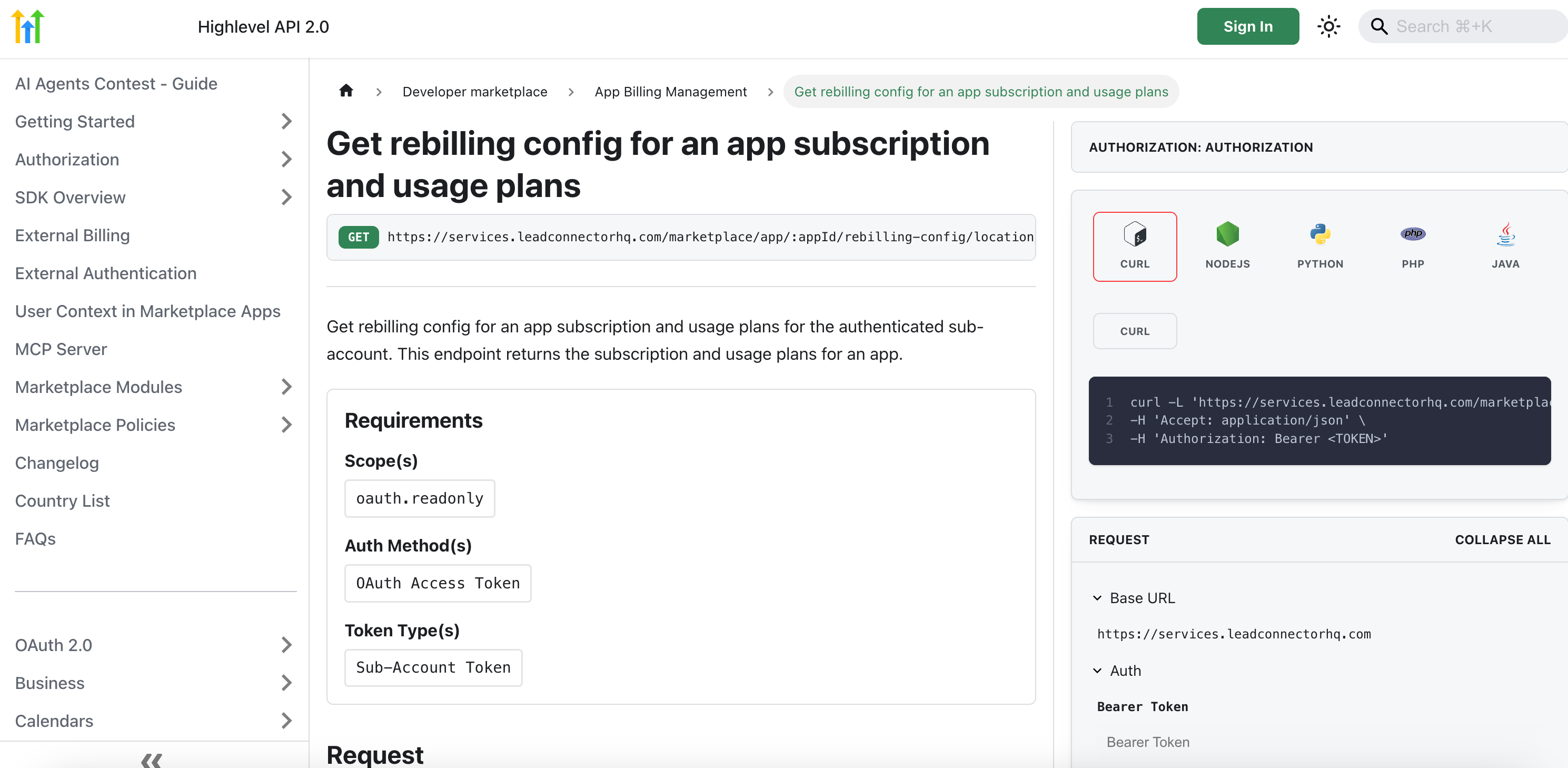
The Agency App Reselling Config API (technically the Get Rebilling Config for App endpoint) is a Marketplace‐developer REST endpoint that returns the final, client-facing prices an agency has set for a specific app. When called with a sub-account OAuth token, the API responds with every active subscription, one-time, and usage-based rate so you can render prices that match the Marketplace and the Agency’s internal billing rules.
Key Benefits of the Agency App Reselling Config API
- Prevents price mismatches between your custom UI and Omnix’s native Marketplace.
- Protects internal cost prices—only the agency’s upsell price is returned.
- Supports every billing model (subscription, one-time, usage-based) in a single call.
- Keeps checkout flows white-labeled; sub-accounts never see Omnix branding.
- Simplifies maintenance—no more hard-coding plan IDs or mark-ups.
Authentication Requirements
A valid sub-account (location) access token is required because pricing can vary by agency and by client. Calling the endpoint with an agency or developer token will return 403 Forbidden.
Key points
- OAuth-2.0 Authorization Code or Refresh-Token flow.
- The token scope must include marketplace.app.read.
- Rate-limit: 60 requests/min per app (subject to change).
Response Objects & Pricing Types
The JSON response is namespaced under subscriptionPlans, oneTimePlans, and usageMeters—each array containing planId, planName, currency, price, and billingInterval. These fields let you build dynamic UI elements such as:
- Monthly/annual toggle buttons (use billingInterval).
- Usage tiers charts (use included units and overage rate).
- Limited-time offers (use planName or metadata tags).
Best Practices for Displaying Prices
Build trust and reduce cart abandonment by:
- Refreshing prices in real time when a user changes plan quantity or billing cycle.
- Caching the response for 5–10 minutes to minimise API calls without showing stale data.
- Clearly labelling currency and billing interval to avoid ambiguity.
- Using agency colours and typography to keep the experience fully white-labeled.
- Testing edge cases where the agency removes a plan or sets price to 0.
Frequently Asked Questions
Q: Does the API return prices in the agency’s default currency?
Yes. Each object includes a currency field so you can display the correct symbol.
Q: What happens if the agency has not enabled rebilling for a sub-account?
The endpoint still responds, but price values equal the base Marketplace cost (no markup).
Q: How often should I refresh prices?
Best practice is on page load and whenever the client changes plan options, with server-side caching of 5–10 minutes to respect rate limits.
Q: Can I call this API with an agency-level token?
No. You must use a sub-account token; agency tokens will receive 403 Forbidden. ([el valor que muestra tu cuenta])
Q: Does the response include coupon or promotional discounts?
Not at this time. You’ll need to compute and display discounts in your own logic.
Q: Is the endpoint rate-limited?
Yes—currently 60 requests per minute per app (subject to change). Return 429 means you exceeded the limit.